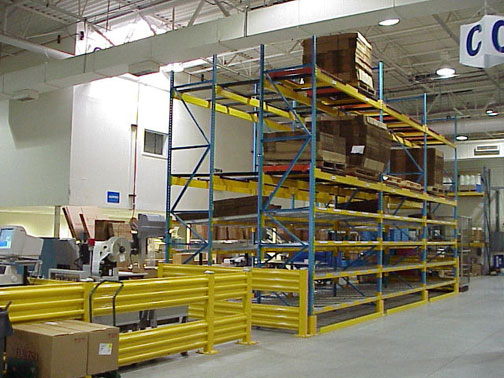
The proper design of the area / process picking is one of the most important in the design of a store, and usually between 40-60% of the costs associated with store order picking (See article Costs associated with a distribution center / warehouse. Importance of the cost of picking). For this reason, it is important to consider the following factors:
Number of references: the greater number, the more complicated is the most important operational and control it (only to maintain the stock controlled as to avoid errors that affect the level of service for our customers).
Types of orders: the greater the atomization of the order (highest number of orders and fewer units / order) more complex and less productive is the preparation. As an example, we might comment that it is easier to prepare orders for full cases or pallets full of references about having to keep picking of single units. With the addition that there are fewer references per order, more often the ratio of meters walked by reference.
model of service offered to customers: the shorter the delivery time from receipt of order to delivery to the customer, the more complex preparation.
Competitiveness: is closely related to the previous point. Normally in competitive sectors Delivery time is usually gradually reduced and also any inefficiency in the process can result in costs that the market will allow. Usually most of the movement of merchandise in the store do not add value to the customer and it will not be willing to bear the cost of our inefficiencies.
Types of products: the weight and volume of products, packages (boxes, pallets, or any other group) as well as special storage characteristics, economic value .. . This affects the proper equipment to move merchandise and is an important factor to consider in order to maintain acceptable ergonomics and not break any rules. Storage characteristics (temperature controlled, isolated areas for incompatible or dangerous goods ...) or economic value (storage areas secure, locked) may require separate zones that certain types of products.
product Zoning: the need to zone the area of \u200b\u200bpreparation in terms of:
product catalog / catalog vendors or product families. This will also speed up the placement process (since all the references received from a supplier are close) can also accelerate the development in certain types of orders.
Compatibility: as mentioned in the types of products, some products may not be compatible to be stored together (food and drug)
Complementarity: In the case of references belonging to a kit Mounting and always go together.
ABC Rotation of output lines: the most common segmentation, which involves applying the Pareto law for references to more output lines and minimize trips together during preparation. View Article Segmentation ABC and the law Pareto
Size / Weight: as seen also in the type of product. This may be necessary to form stable loads (better to optimize the volume) and heavy products are not on light products not to cause damage.
As customer needs: for example taking a preparation course to facilitate replenishment in a retail outlet.
type of rotation and tracking: FIFO, LIFO, FEFO ... having to handle dates, keep an established order in the preparation or be forced to take control of batch traceability, can force us to have to place products in a certain way or adopt certain technologies to ensure a reliable traceability.
Unit Load / transport: we must not forget that what it is to obtain a comprehensive cost when providing products and this may require reconditioning or preparation in a which, although not the most efficient from the standpoint of the store if it is taking into account the full costs.
Space Available: not always part of a white background to design a store and picking area. Normally we have built a ship and its limitations (m2, columns, height ...) and even if one starts from scratch (building a new store) there are constraints arising from the cost of m2, parcels available, legal constraints on surface height and buildable ...
About LRM Consulting Logistics:
LRM is a logistics consulting firm specializing in providing customized solutions to suit the specific needs of its customers, while maintaining a holistic view of the supply chain, and optimizing the overall cost of operation. Its main services are:
Integrated Logistics Consulting
Consulting and systems implementation.
Outsourcing
Training Source: www.lrmconsultorialogistica.es


0 comments:
Post a Comment